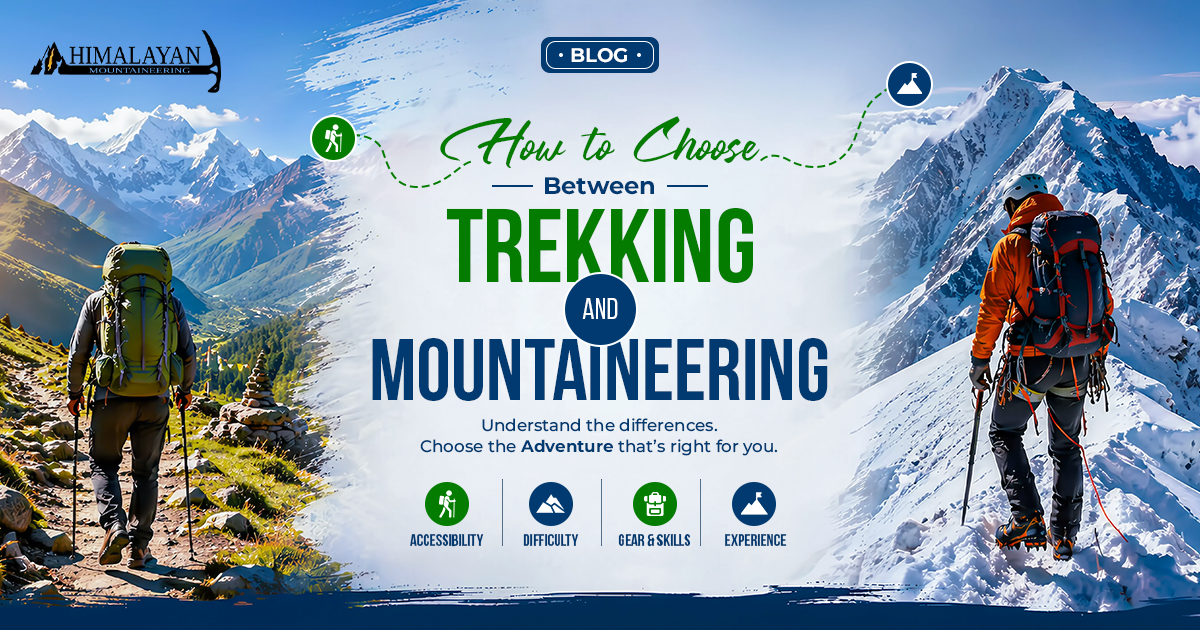
Nepal is also known as one of the top adventure travel destinations in the world and attracts thousands of adventurers each year. But still, many travelers get confused about what to choose while planning their adventure in the Himalayas between Trekking and Mountaineering. This is why although both activities will provide you with phenomenal mountain experiences, they require different levels of fitness, skills, equipment and commitment.
A proper understanding of the difference between Trekking and Mountaineering helps one to follow their goals effortlessly according to their physical requirements and experience.
Understanding Trekking and Mountaineering
The interest in trekking and mountaineering has been growing in popularity and the need to understand the definitions of the two terms has become of utmost importance.
Trekking is defined as a recreational activity taking place on one of the mountains’ paths, valleys, woods, and faraway villages for a long period of time. The famous trekking areas in Nepal include Everest base camp trek, Annapurna circuit trek, and Manaslu circuit trek.
In contrast to trekking, mountaineering is the activity of climbing mountains. Along with climbing skills, mountaineering requires special equipment like ropes, crampons, and ice axes.
While trekking also refers to going hiking in mountains, mountaineering is the activity of climbing the mountains' summits.
Choose Trekking if You Want Scenic Adventure
For those wishing for a beautiful experience, trekking is the best choice. For most tourists it is the best travel activity. Trekking is more accessible than mountaineering. You should prefer trekking in case:
- You are a beginner traveler.
- You prefer a walk to climbing.
- You would like to get acquainted with local culture and villages.
- You can’t climb technically.
- You seek cheaper traveling.
Trekking provides an amazing opportunity to enjoy all views without risks which are connected with technical climbing.
Consider Mountaineering if You Seek a Challenge of a Summit
Mountaineering, which is geared towards standing on the peak of a mountain, may be an appropriate choice for you if this is your goal. Trekking and mountaineering both need some degree of health and fitness, but mountaineering asks for much more in terms of preparation involved.
Mountaineering might be a good option for you if you:
- I have trekking experience before.
- Like challenges that involve a lot of physical activity.
- Are ready for extensive training.
- Are interested in learning climbing techniques.
- I wish to reach a mountain summit.
Some of the most popular mountains to climb in Nepal are Island Peak, Mera Peak, Lobuche Peak, and Manaslu Mountain where you will be required to have quite a lot of endurance and determination in order to make it to the summit.
Fitness Considerations
Fitness is one of the most significant factors in comparing Trekking and Mountaineering activities.
The physical abilities usually needed for trekking are a good cardiovascular fitness level and the capacity to walk for many hours a day. Most trekkers prepare themselves through regular walking and hiking activities in addition to some simple physical exercises.
Mountaineering though requires advanced physical conditioning. Climbers usually undergo months of workouts aimed at building strength, endurance and tolerance to altitude. A summit day usually lasts 10 to 15 hours and includes climbing in the tough conditions.
Differences in Equipment
One more crucial distinction between trekking and mountaineering is the equipment to be used.
Essential gear needed for trekking involves:
- Trekking boots
- Rucksack
- Winter clothes
- Trekking poles
- Sleeping mat
For mountaineering, extra tools can be:
- Crampons
- Ice axe
- Climbing harness
- Helmet
- Ascenders
- Technical climbing gear
The extra tools required for mountaineering can make the whole experience much more complicated and thereby costly.
Price Comparison
Price is an essential point in making a decision between trekking and mountaineering.
The trekking experience is cheaper because it requires fewer permits, tools, and logistical support.
In the case of mountaineering, permits for climbing, professional gear, guides, and Support from Sherpas, as well as a number of safety measures, make mountaineering an activity that costs a lot more than trekking.
Choosing Between Trekking and Mountaineering
The decision of whether to go trekking or mountaineering lies on the level of what the person has accomplished in his/her life, as well as on one’s degree of fitness, price, and personal ambitions.
If you would like to explore beautiful places in the Himalayas, get acquainted with the cultures of people living there, and have moderate physical challenges, then trekking is for you.
If you are looking for something more adventurous and challenging, and want to enjoy the feeling of reaching the summit of a mountain, then mountaineering is the right choice for you.
Trekking is a good basis for mastering mountaineering as many climbers start with trekking before they become mountaineers.
Conclusion
Selecting between Trekking and Mountaineering is vital for organizing your Himalayan journey. Trekking includes beautiful scenery, culture, and easy travel to the mountains while mountaineering means reaching the peak. Regardless of whether you opt for Trekking or Mountaineering, proper preparation, training, and guidance are crucial. It is important to know the differences and also to determine what you need to do to realize your dreams.
FAQ
1. What's the major distinction between trekking and mountaineering?
Trekking is simply walking across Zermatt and mountaineering refers mainly to walking up the heights of mountains with the help of gadgetry.
2. Is trekking easier than mountaineering?
Certainly. Trekking has little technical features and generally asks for little equipment.
3. Is it suitable for a novice to try mountaineering?
Of course not. First of all, the novice should master trekking experiences before making an attempt.
4. Is trekking less expensive than mountaineering?
While trekking can be expensive, mountaineering is usually costlier.
5. What are quintessential beginner mountains in Nepal?
Island Peak, Mera Peak, and Mt. Lobuche are considered to be the most suitable for beginners for climbing.
6. What are the advantages of trekking and mountaineering in Nepal?
Nepal is known for the most famous trekking routes, gorgeous nature, professional guides, and the world’s best climbing mountains.