Everest vs K2 Expedition: Which Expedition Is Right for You?
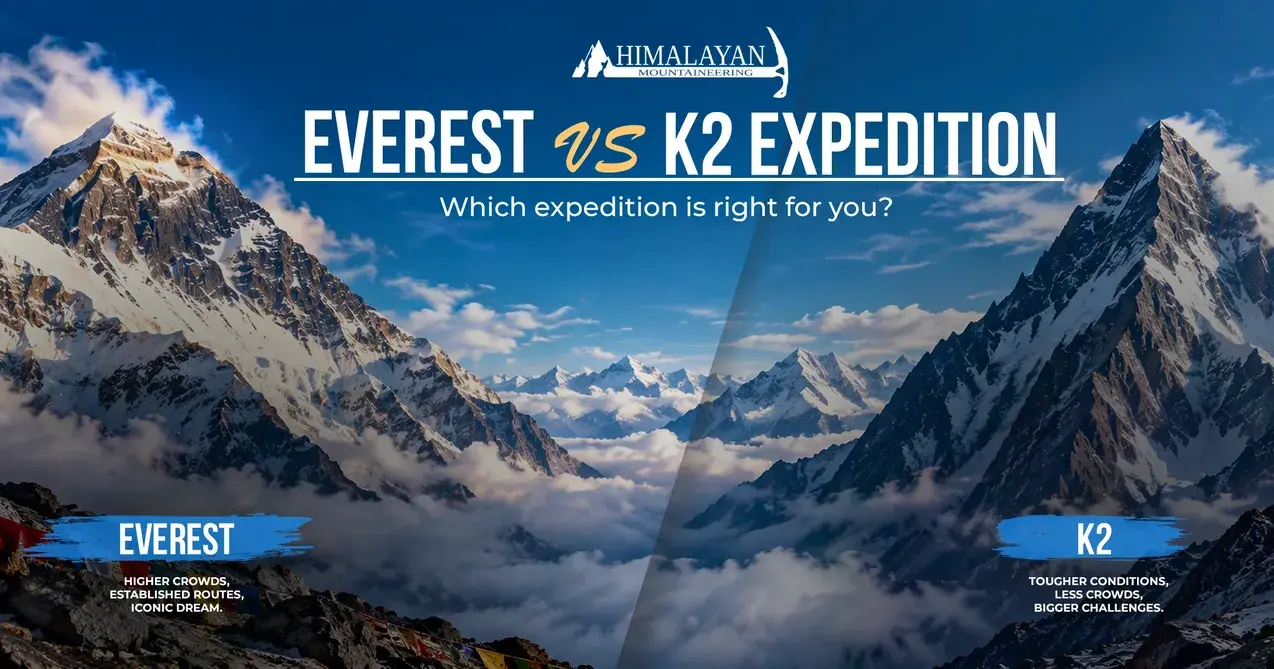
For those mountaineers who pursue climbing the highest mountains, there are only two choices to consider: Mount Everest or K2. Each of these mountains reaches an altitude of more than 8,000 meters, requires serious preparation, and has an unforgettable experience to offer. Nevertheless, the Everest and K2 expeditions are very different from each other, and knowing the differences can be useful before setting out on one of these two ascents.
This article will provide a comparison of Mount Everest and K2 with the aim of helping climbers select the most appropriate expedition according to their personal preferences, whether it is difficulty, technical requirements, success rate, danger, or climbing experience.
Learning About Mountains
Mount Everest
With a height of 8,849 meters, Mount Everest is the tallest mountain in the world. Climbers come from distant places to climb Mount Everest. With established routes, evolving support systems, and many years of experience climbing, the mountain is easily accessible.
K2 is the second-tallest mountain in the world, with a height of 8,611 meters. Because it is not very tall, K2 is known to be one of the most difficult mountains to climb in the world. The mountain has steep and technical slopes, unpredictable weather, and also many potential dangers.
Everest vs K2 Expedition: Key Differences
When comparing an Everest vs K2 Expedition, the biggest difference is not altitude but technical difficulty.
| Factor | Everest Expedition | K2 Expedition |
| Height | 8,849m | 8,611m |
| Technical Difficulty | Moderate to High | Very High |
| Fixed Rope Usage | Extensive | Extensive but more technical |
| Summit Success Rate | Higher | Lower |
| Objective Hazards | Moderate | High |
| Climbing Experience Required | Advanced | Expert |
| Rescue Possibilities | Better | Limited |
While Everest challenges climbers with altitude and endurance, K2 requires advanced mountaineering skills in addition to physical fitness.
K2 vs Everest Difficulty
One of the most frequently asked questions is about K2 vs Everest Difficulty.
Why Everest Is Difficult
An Everest Expedition requires climbers to spend weeks at extreme altitude. The biggest challenges include:
- Thin oxygen levels
- Long expedition duration
- Harsh weather
- Physical exhaustion
- Mental resilience
Although Everest is physically demanding, much of the route is fixed with ropes, ladders, and established camps.
Why K2 Is More Difficult
The discussion of K2 vs Everest Difficulty usually favors K2 as the more demanding mountain. Climbers face:
- Steeper slopes
- Technical rock climbing
- Narrow ridges
- Exposure to rockfall and avalanches
- More complex route finding
- Severe weather conditions
Unlike Everest, where many sections involve straightforward movement on fixed ropes, K2 demands constant technical focus from Base Camp to summit.
Experience Requirements
Everest Expedition Requirements
Most operators recommend:
- Previous 6,000m and 7,000m climbs
- Excellent physical conditioning
- Experience using crampons and ice axes
- Familiarity with fixed ropes
Many climbers use peaks such as Island Peak, Lobuche East, or Ama Dablam as preparation for an Everest Expedition.
K2 Expedition Requirements
A K2 Expedition is suitable only for highly experienced climbers. Typical requirements include:
- Successful 7,000m climbs
- Previous 8,000m expedition experience
- Strong technical climbing skills
- Advanced rope management
- Ice and mixed terrain expertise
Most K2 climbers already have extensive high-altitude mountaineering backgrounds.
Acclimatization and Expedition Length
Both mountains require careful acclimatization.
A typical Everest Expedition lasts around 60 days, including acclimatization rotations through higher camps before the summit push.
A K2 Expedition generally lasts 50 to 60 days and follows a similar acclimatization strategy. However, climbers often spend more energy negotiating technical terrain during rotations.
Both expeditions rely on the "climb high, sleep low" principle to prepare the body for extreme altitude.
Summit Success Rates
Summit success rates can vary by season, weather conditions, and route.
An Everest Expedition generally offers higher summit success rates due to:
- Better infrastructure
- Established camps
- More support personnel
- Extensive weather forecasting
A K2 Expedition traditionally has lower summit success rates because of:
- Technical climbing challenges
- Limited weather windows
- Greater objective hazards
- More demanding summit day
These factors make K2 a more selective mountain for experienced climbers.
Which Mountain Is Safer?
Neither mountain should be considered safe. Every 8000m Peak Expedition carries serious risks.
However, Everest benefits from:
- Better communication systems
- More rescue resources
- Larger expedition support networks
- Well-established climbing routes
K2 presents additional dangers through technical terrain and unpredictable weather, making risk management even more critical.
Choosing the Right 8000m Peak Expedition
If your goal is to complete your first 8000m Peak Expedition, Everest is often the preferred choice. It provides valuable experience at extreme altitude while allowing climbers to focus primarily on endurance and acclimatization.
If you already have significant high-altitude experience and are looking for a greater technical challenge, a K2 Expedition may be the logical next step.
Choose Everest If:
- You are attempting your first 8,000m climb.
- Your primary goal is reaching the world's highest summit.
- You want a structured expedition environment.
- You have strong endurance but limited technical climbing experience.
Choose K2 If:
- You have previous 8,000m experience.
- You enjoy technical mountaineering.
- You seek one of the world's greatest climbing challenges.
- You are comfortable operating in highly exposed terrain.
Conclusion
The choice of whether to climb Mount Everest vs K2 Expedition is an individual one. Personal climbing experience, skills, and goals play important roles in this choice. An Everest expedition will allow you to stand on the top of the world and is often the first mountain climbed in the world of high-altitude climbing.
A K2 expedition is considered one of the most difficult in the world of climbing. If we compare Everest vs K2 Expedition, K2 climb is understood to be really more technical and risky than Everest climb but Everest has more challenges related to high altitude.
Either way, both mountains are considered the best climbs among all 8000 m peaks.
Frequently Asked Questions (FAQ)
Is K2 more challenging than Everest?
Yes, When it comes to comparing the K2 difficulty with the Everest difficulty, most of the mountaineers believe that K2 is much more challenging. K2 features steeper climbing routes, technical ice and rock climbing, and is exposed to more hazard elements than Everest. Even though Mount Everest is the highest of the two, K2 requires much stronger technical climbing skills.
Which mountain is more perilous, Everest or K2?
Both mountains are dangerous, but a K2 expedition is considered to be more dangerous due to its technicality, erratic weather, and limited rescue opportunities. Climbers need to have considerable mountaineering skills before attempting K2.
Are beginners able to do an expedition on Everest?
No. An Everest expedition requires extensive prior experience on high-altitude mountains. Most climbers start with several 6,000m and 7,000m peaks and gain experience in glacier traveling, ice climbing, and using fixed ropes.
Which mountain should I scale first: Everest or K2?
Everest is considered to be the first choice for climbing an 8000m peak. Once the climbers gain sufficient experience of the Everest climb and of other famous peaks, they can opt for the K2 Expedition.
What are the requirements of a K2 Expedition?
The climbers have to be well-trained for climbing on ice, mixed climbing, rope handling, climbing on glaciers, performing a self-rescue as well as climbing at high altitudes.
Why are Everest and K2 compared?
Everest and K2 are often compared since they are the highest mountains on the planet. Climbers analyze them by comparing their height, difficulty of the climbing task, chance of success, risks, and other parameters.