Ama Dablam (6,812m): A Peak Defined by Its Line, Not Its Altitude
About Mt. Ama Dablam
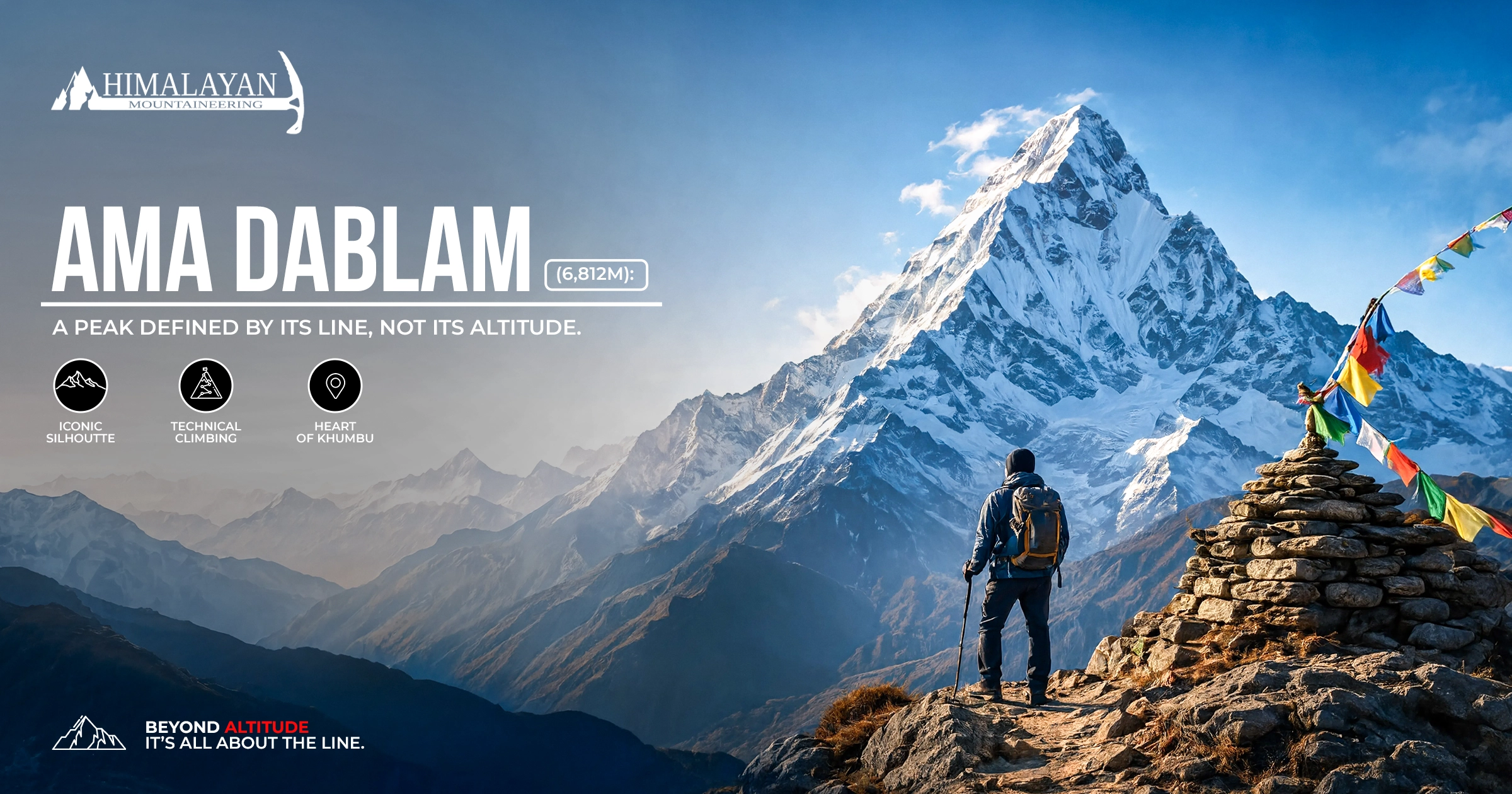
Ama Dablam rises above the Khumbu Valley near Tengboche Monastery, its distinctive pyramid silhouette visible for much of the classic Everest Base Camp trekking route. Ama Dablam — meaning “Mother’s Necklace” in Sherpa language — derives its name from the long ridges flanking the mountain like a mother’s arms, and the hanging glacier at its center resembling the traditional double-pendant (Dablam) worn by Sherpa women. Long nicknamed the “Matterhorn of the Himalayas” for its sharp, symmetrical profile, it follows the Southwest Ridge from a Base Camp at roughly 4,600 metres through three progressively more exposed high camps to a 6,812-metre summit. The technical grade is what sets it apart: steep rock pitches rated in the III–V range, a vertical rock step known as the Yellow Tower, knife-edge sections of mixed snow and ice. This guide covers what an Ama Dablam expedition actually demands — technically, physically, and in terms of planning — for climbers weighing it as a serious objective.
Ama Dablam Expedition
Ama Dablam does not ask what most Himalayan giants ask. At 6,812 metres it never reaches what mountaineers classify as extreme altitude, and yet it is routinely ranked among the more demanding standard routes below 7,000 metres anywhere in the range. What makes it serious is the climbing itself: sustained rock pitches, an exposed ridge line, and a summit day that tests technical competence as much as endurance. It is that combination — modest altitude, real technical difficulty — that has made Ama Dablam one of the most sought-after objectives in Nepal for climbers who already know how to move on rock and ice.
Why Ama Dablam Is a Distinctive Himalayan Objective
Most Himalayan expeditions above 6,000 metres are built around a familiar structure: a staged acclimatisation programme, camp rotations, and a summit push timed to a weather window. Ama Dablam follows that same outline, but the climbing in between looks nothing like a typical high-altitude trekking peak.
Where many 6,000–7,000-metre objectives are largely a fitness and altitude test over moderate terrain, Ama Dablam is a genuine alpine climb set at altitude. Multi-pitch rock, sustained fixed-line work, and a summit ridge with real exposure on both sides mean the technical demands do not ease off as the route gains height — if anything, they intensify closer to the top, exactly when climbers are most fatigued and least oxygenated.
A Proving Ground before 7,000m and 8,000m Objectives
Ama Dablam has earned a reputation as one of the standard “next step” peaks for climbers building toward Himalayan giants. It sits below the 7,000-metre threshold where extreme-altitude physiology becomes the dominant factor, which means a team can test technical systems — fixed-line movement, multi-camp rotations, harness and crampon technique on real rock — without extreme altitude compounding every decision. Climbers who perform well on Ama Dablam's Southwest Ridge carry that technical foundation directly into bigger objectives, where the margin for hesitation on exposed terrain narrows considerably.
It is not, for that reason, a mountain to be underestimated as merely a stepping stone. The climbing stands on its own as one of the more demanding standard routes in the Khumbu, and it should be approached with the same seriousness as any technical alpine objective.
What Makes Climbing Ama Dablam Physically and Technically Demanding
Ama Dablam is not simply a longer version of a trekking peak with a harder name — it combines sustained technical climbing with the physiological load of sleeping and working above 6,000 metres for multiple weeks.
- Multi-pitch rock climbing at altitude changes the calculus entirely. Movement that would be straightforward at sea level becomes deliberate and energy-costly above 6,000m, where reduced oxygen slows grip strength, balance, and recovery between pitches.
- Exposure compounds fatigue-driven error. Long sections of the route sit on narrow ridgelines with significant drops on either side, where a lapse in concentration late in a summit push carries real consequences.
- The terrain shifts constantly. Climbers move between bare rock, snow-covered ledges, and glazed ice within single pitches, often switching technique — rock shoes to crampons, hands to ascender — several times in a day.
- Camp 3's position beneath the Dablam ice formation adds an overhead hazard most 6,000m peaks do not have, requiring careful route selection and timing to limit exposure under the ice cliff.
None of this rules the climb out for a well-prepared team — it simply means technical competence has to be automatic, not something built on the mountain itself.
Rock, Ice, and Route Conditions on the Southwest Ridge
Conditions on Ama Dablam change more from section to section than almost anywhere else in the Khumbu, since the route crosses bare rock, snow-loaded ledges, and glaciated ice within a single climbing day.
- The Yellow Tower, a roughly 20-metre near-vertical rock step around grade 5A, is the technical crux of the route and the section most climbers point to when describing the mountain's difficulty.
- The Grey Tower and the sections around Camp 2 add sustained exposed rock scrambling, often climbed with a mix of natural holds and fixed protection.
- Mushroom Ridge, above Camp 2, is a narrow, wind-sculpted snow arete that demands careful footwork and full concentration in exposed, often windy conditions.
- Snow and ice conditions above Camp 3 vary significantly by season and recent weather, from firm neve that climbs quickly to breakable crust that slows a summit push considerably.
Because conditions shift from one rotation to the next, an experienced operator treats the route as something to be assessed continuously rather than fixed at the start of the season — what was climbable snow on the acclimatisation rotation can be entirely different by summit push.
Technical Skills Required for an Ama Dablam Expedition
Ama Dablam rewards climbers who arrive with real rock and ice competence already built, not developed for the first time on the mountain.
- Multi-pitch rock climbing experience, ideally up to grade IV–V, with genuine comfort moving over exposed rock in mountaineering boots rather than rock shoes.
- Fixed-line proficiency, including efficient ascender use, transitions between rope sections, and the stamina to jumar for extended stretches at altitude.
- Ice and mixed climbing technique, sufficiently ingrained to be automatic when hands are cold and oxygen is limited.
- Rappelling competence under load and in exposed positions, essential for the descent from Camp 3 and the tower sections.
- Crampon and ice axe technique on steep terrain, including front-pointing and secure movement on narrow ridgelines.
- Prior high-altitude camp experience, since living and moving efficiently above 6,000 metres for several weeks is its own skill, separate from the climbing itself.
This blend of technical climbing ability and high-altitude camp experience is what separates climbers who are genuinely ready for Ama Dablam from those better served by a technical trekking peak like Island Peak or Lobuche East first.
Acclimatisation and the Physiological Demands
At 6,812 metres, Ama Dablam sits below the extreme-altitude threshold, but climbers still spend extended periods above 6,000 metres, where oxygen availability, sleep quality, and appetite are all measurably affected. Combined with the physical output of sustained technical climbing, this makes fatigue management as important as the climbing itself.
A staged acclimatisation programme — progressive rotations to Camp 1 and Camp 2, deliberate rest at Base Camp, and a summit push only once the team is genuinely ready — remains the foundation of a successful expedition. Rushing the rotations to save time on a fixed itinerary is one of the more common reasons technically capable climbers fail to summit or run into trouble high on the route.
Equipment for an Ama Dablam Climb
An Ama Dablam kit has to cover technical rock climbing and high-altitude camp life at once — there is no single dominant terrain type to pack for.
- Climbing equipment: mountaineering boots suited to mixed rock and ice, crampons, ice axe, harness, ascender, and a full rack of carabiners and slings for the fixed sections.
- Rock climbing layer: approach-friendly gloves or fingerless liners for the tower sections, where dexterity on rock matters as much as warmth.
- Cold and altitude protection: a high-altitude down suit or equivalent layering system, and glacier glasses for the snow and ice sections above Camp 2.
- Rope and rappel gear: a personal rappel device, prusik cords, and familiarity with the team's fixed-rope system for both ascending and descending the same lines.
- Camp and expedition logistics: durable, wind-rated tents for the exposed Camp 2 and Camp 3 sites, high-altitude sleeping systems, and a reliable stove setup for melting snow at altitude.
Every item on this list earns its place because of the route's dual nature — technical rock one pitch, glaciated snow the next — with no easy resupply once the team is committed above Base Camp.
How Expeditions Assess Route and Weather Conditions
The decision to push for the summit — or to climb through a particular section of the ridge — is made continuously by experienced guides, based on several factors evaluated in real time:
- Recent snowfall and wind loading, which determine whether the ridge sections and the ground below the Dablam ice cliff are safe to cross.
- Rock conditions on the Yellow Tower and Grey Tower, since wet or verglassed rock changes the climbing difficulty considerably.
- Wind exposure on the summit ridge, where sustained wind can make an otherwise climbable day untenable.
- Time and pacing through the technical sections, since slow movement on the towers can push a summit attempt into afternoon conditions or darkness on the descent.
- The team's physical and mental state, honestly assessed, particularly grip strength and coordination on the exposed pitches after a long, cold night.
When conditions on a given rotation do not support safe climbing, the sound call is to wait or reroute the day — the itinerary sets out a plan, not a guarantee, and the mountain has the final say.
Who Is Qualified for an Ama Dablam Expedition
Ama Dablam is not an introduction to high-altitude mountaineering — it is an objective for climbers who already climb comfortably on rock and ice before altitude is added to the equation.
- Climbing background: demonstrated multi-pitch rock and ice climbing experience, plus at least one prior expedition to a technical trekking peak such as Island Peak or Lobuche East.
- Physical conditioning: strong grip and upper-body endurance for sustained pitches, alongside the cardiovascular base for long summit days above 6,000 metres.
- Cold-weather resilience: prior experience managing cold hands and feet during technical climbing, not just standing exposure in camp.
- Judgment under exposure: the composure to keep climbing decisions sound on narrow, exposed terrain while fatigued — arguably the defining qualification for this particular mountain.
For climbers who meet that profile, Ama Dablam is frequently described as one of the most rewarding technical climbs in the Himalaya — a genuine alpine objective that does not require extreme-altitude experience to attempt, but does require real climbing competence to enjoy.
Why This Objective Appeals to Experienced Climbers
There are relatively few Himalayan peaks where a striking, iconic line and genuinely technical climbing come together below the extreme-altitude threshold. Ama Dablam's Southwest Ridge, its towers, and its narrow summit ridge put it firmly on that short list.
For climbers who already have the rock and ice skills, that combination is the draw: a mountain that tests technique and composure pitch by pitch, set against one of the most photographed skylines in the Everest region, without demanding the extreme-altitude experience of a 7,000m or 8,000m peak.
Interested in joining a future Ama Dablam Expedition with Himalayan Mountaineering?
Explore our upcoming departures or get in touch with our team to start planning your climb. Contact us at: info@himalayanmountaineering.com or visit our page www.himalayanmountaineering.com
FAQs about Ama Dablam Climbing
How difficult is Ama Dablam to climb?
Ama Dablam is considered one of the more technically demanding standard routes among Himalayan peaks below 7,000 metres, with sustained rock pitches up to grade V, exposed ridgelines, and a vertical rock crux at the Yellow Tower. It is not an extreme-altitude climb, but it is a serious technical one that demands genuine rock and ice climbing ability.
What is the best season to climb Ama Dablam?
Autumn (October–November) is the most popular and generally most stable season, with pre-monsoon spring (April–May) offering a quieter alternative. Both windows tend to bring more predictable weather and firmer route conditions than the monsoon or winter months.
Do I need prior climbing experience before attempting Ama Dablam?
Yes. Ama Dablam is not considered a suitable first Himalayan climb. Prior multi-pitch rock and ice climbing experience, along with at least one technical trekking peak such as Island Peak or Lobuche East, is strongly recommended before attempting the Southwest Ridge.
What is the Yellow Tower?
The Yellow Tower is a roughly 20-metre near-vertical rock step around grade 5A that forms the technical crux of the standard route, typically climbed on fixed ropes just below Camp 2.
How long does a typical Ama Dablam expedition take?
Most expeditions run three to four weeks in total, covering the trek to Base Camp, a staged acclimatisation and rotation programme through the high camps, and a weather-dependent summit window.
Is a permit required to climb Ama Dablam?
Yes. Ama Dablam requires a climbing permit issued by Nepal's Department of Tourism, along with the standard Sagarmatha National Park entry and local area permits along the approach route, typically arranged by the expedition operator.
What is the main hazard on Ama Dablam?
The primary hazards are rockfall and icefall on the exposed tower sections, combined with the sustained technical difficulty of the route itself — a slip on steep rock or ridge terrain carries more consequence here than the altitude alone.